The VR Confessional
A contemplative social VR space for stress relief, designed around the praxis of confession.
Jonathan Brandes · Levi Dal Canton
Demo & Project Submission · 4 May 2026
Who is the space designed for?
Primary audience: students at Zeppelin Universität, especially those carrying acute or chronic stress.
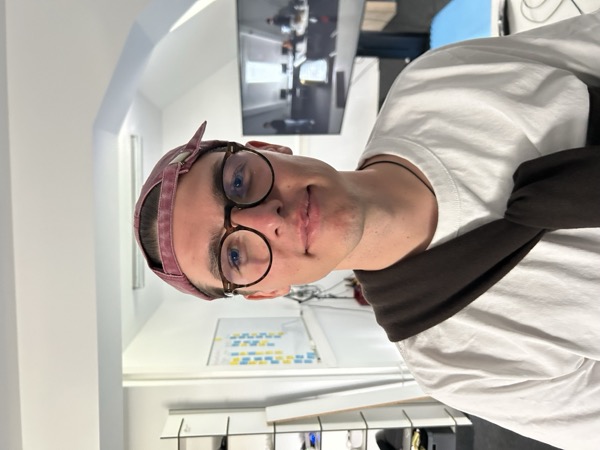
Max
23 · Bachelor's student
"I'm just having a bad time. I don't really want to talk to anyone — but I need to say something."
Going through a rough patch. Wants somewhere quiet to put it down without performing.
Jonas
26 · Doctoral candidate · second year
"It's been a strange year. I just want a place that doesn't ask me to perform."
Chronic isolation. Wants quiet presence — not advice, not solutions, just being heard.
Why a confessional?
- Disclosure benefits from scaffolding. Pennebaker's expressive-disclosure paradigm shows measurable stress-reduction effects from articulating difficult experiences. A blank chat box is high-friction; a ritualised setting lowers the cost of starting.
- Less judgment, more disclosure. Lucas et al. find that perceived AI listeners reduce social-evaluation anxiety and increase willingness to disclose — directly applicable to our agent.
- Confession is a cross-cultural form. The act of speaking to an unseen, attentive listener appears in many traditions. The form is recognisable; the onboarding cost is low.
Cultural framing. The praxis is borrowed; the religion is not. The space is a temple — open to all — rather than a church. The agent's avatar reads as religious without belonging to any one tradition.
What kind of communication does this space support?
A private, voice-based dialogue between a single user and a non-judgmental listener inside a contemplative virtual environment.
- Modality. Voice in / voice out. The user speaks aloud; the listener responds aloud.
- Privacy. Per-user memory with the listener; no recording; voices contained to the booth.
- Listener. An AI agent or, equivalently, another human session participant — the role is portable.
Theoretical grounding: Pennebaker (1997) on the therapeutic effect of disclosure; Lucas et al. (2014) on reduced disclosure inhibition with virtual humans. See §5.
Why the room feels the way it does.
References
- Pennebaker, J. W. (1997). Writing about emotional experiences as a therapeutic process. Psychological Science, 8(3), 162–166.
- Lucas, G. M., Gratch, J., King, A., & Morency, L.-P. (2014). It's only a computer: Virtual humans increase willingness to disclose. Computers in Human Behavior, 37, 94–100.
How the two of us worked.
| Area | Work |
|---|---|
| Environment | Sourced and integrated a temple model from Sketchfab; baked dim warm lighting; placed ambient candles. |
| Booth | Built the confessional structure inside the temple, with lattice between the two sides and a table on the visitor's side. |
| Curtain | Implemented as NetworkStateTrigger_GenericMovable with a proximity trigger zone; abandoned the Animator-based approach after debugging revealed it was fragile in ENGAGE. |
| Holdable candle | Network Object pattern with light component; added the side-table for candle drop-off prior to teleport. |
| AI agent | Configured in ENGAGE: voice in / voice out, per-user memory, non-denominational avatar. |
| Presentation | This deck, deployed at confessionary.kanonindustries.com and opened on the in-world ENGAGE browser. |
Working pattern: at every step one of us was researching while the other was deploying — then we swapped. Same room, same screen, two pairs of hands moving in turn. Each row above was touched by both of us at different points.
Thank you. Questions welcome — and afterwards, the room.